Cycle & Hormones
A Sharp Pain During Ovulation? Here's What Your Body May Be Trying to Tell You
That sudden twinge in the middle of your cycle isn't always random. It may actually be one of the clearest signs that your body…
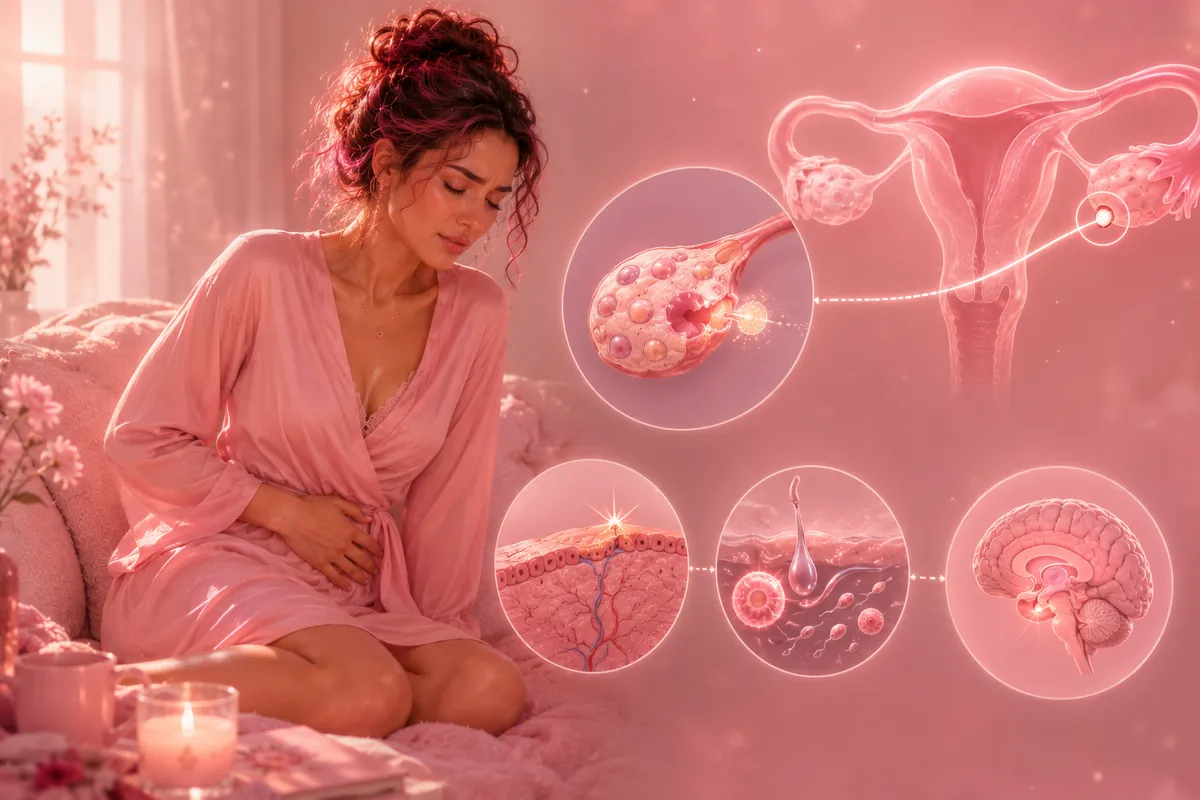
A Sharp Pain During Ovulation? Here's What Your Body May Be Trying to Tell You
Have you ever felt a sudden pinch on one side of your lower abdomen and wondered if something was wrong?
It may last only a few minutes.
Or it may linger for several hours.
For many women, this mysterious discomfort appears around the middle of their menstrual cycle and disappears almost as quickly as it arrived.
Most people are never taught what it is.
In fact, it even has its own medical name: Mittelschmerz, a German word meaning "middle pain."
Far from being a sign that your body is failing, ovulation pain is often evidence that one of the most remarkable events of your cycle is taking place—the release of an egg that has been quietly developing for weeks.
Understanding why this happens can turn an unexpected ache into a fascinating insight about your body.
Your Ovary Doesn't Simply Release an Egg
Many people imagine ovulation as an egg gently slipping out of the ovary.
The reality is far more dramatic.
Every month, several tiny fluid-filled sacs called follicles begin growing inside the ovary.
Each follicle protects and nourishes an immature egg.
Usually, only one follicle becomes dominant.
As ovulation approaches, it continues filling with fluid until it resembles a tiny water balloon sitting on the surface of the ovary.
Then something extraordinary happens.
Triggered by a surge of luteinizing hormone (LH), that follicle ruptures, releasing the mature egg into the nearby fallopian tube.
That tiny rupture is one reason some women feel ovulation pain.
Why Does It Hurt?
The discomfort doesn't usually come from the egg itself.
An egg is microscopic.
You could never feel it moving.
Instead, several small events may contribute to the sensation.
When the follicle bursts, it releases:
- the egg
- follicular fluid
- occasionally a tiny amount of blood
That fluid can briefly irritate the delicate lining surrounding the abdominal organs, called the peritoneum.
Unlike the ovary itself, this lining is very sensitive.
Think of it like a drop of lemon juice landing on a small paper cut.
The amount is tiny, but the surrounding tissue notices immediately.
For many women, that temporary irritation is what creates the familiar sharp twinge.
Why Is the Pain Usually Only on One Side?
One of the most interesting clues about ovulation pain is its location.
Most women notice it on either the left or the right side—not both.
That's because only one ovary usually releases an egg during each cycle.
Contrary to a common myth, the ovaries don't always take turns like clockwork.
One ovary may ovulate several months in a row before the other becomes active again.
That's why the side of your ovulation pain can change—or sometimes stay the same—for several cycles.
Your ovaries aren't following a schedule.
They're responding to whichever follicle becomes dominant that month.
A Small Pain That Can Teach You About Your Cycle
Ovulation pain often arrives alongside other subtle signs that fertility is at its highest.
You might also notice:
- cervical mucus becoming clear and stretchy, similar to egg whites
- a slightly higher interest in intimacy
- mild bloating
- increased energy
- heightened sense of smell in some women
These changes are driven by rising estrogen and the release of the egg.
Rather than viewing ovulation pain as an inconvenience, many women use it as a natural clue that helps them better understand their cycle.
Your body often communicates long before a calendar does.
When Is Ovulation Pain Considered Normal?
Typical ovulation pain is usually:
- felt on one side
- mild to moderate
- short-lived
- occurring around the middle of the menstrual cycle
It may last anywhere from a few minutes to a day or two.
For some women, it happens every month.
Others never experience it at all.
Neither is more "normal."
Just as some women experience stronger menstrual cramps than others, ovulation sensations vary widely.
No two cycles are exactly alike.
When Should You Pay Attention?
Although ovulation pain is usually harmless, severe or unusual pelvic pain should never be ignored.
Speak with a healthcare professional if the pain:
- becomes intense or unbearable
- lasts several days
- is accompanied by fever or vomiting
- causes dizziness or fainting
- occurs outside the middle of your cycle
- is associated with unusually heavy bleeding
Conditions such as ovarian cysts, endometriosis, pelvic inflammatory disease, or ovarian torsion can sometimes cause symptoms that resemble ovulation pain.
Understanding your body's normal patterns makes it easier to recognize when something feels different.
Supporting Your Body During Ovulation
Most ovulation discomfort settles naturally.
If you're feeling uncomfortable, gentle care may help.
A warm heating pad can relax nearby muscles.
Light walking or stretching often feels better than remaining completely still.
Staying hydrated supports overall wellbeing, while adequate magnesium-rich foods may help healthy muscle function throughout the cycle.
Sometimes, the most effective remedy is simply knowing what's happening inside your body.
Understanding often replaces worry with confidence.
Bloom Reflection
Your menstrual cycle isn't just about periods.
It's a month-long conversation between your brain, hormones, ovaries, and uterus.
Ovulation pain is one small sentence in that conversation.
The more you learn its language, the more connected you'll feel to your own body.
Bloom Tips
- Track ovulation pain alongside your menstrual cycle.
- Notice which side the discomfort appears on.
- Stay hydrated and use gentle heat if needed.
- Don't panic if you never experience ovulation pain—many women don't.
- Seek medical advice if pelvic pain becomes severe or unusual.
Today's Bloom
This month, pay attention to the middle of your cycle.
Instead of wondering, "Why does this hurt?", ask,
"What is my body telling me today?"
Learning your body's natural rhythms is one of the most empowering forms of self-care.
Bloom Reminder
Every month, one tiny cell begins a remarkable journey that lasts only moments but represents one of the most extraordinary processes in human biology.
Sometimes, your body lets you feel that moment.
Not as a warning—
but as a quiet reminder that incredible things are happening beneath the surface, even when you cannot see them.