Cycle & Hormones
Understanding Your Hormones
They shape your mood, your skin, your energy and your cravings — yet most of us have never been properly introduced.
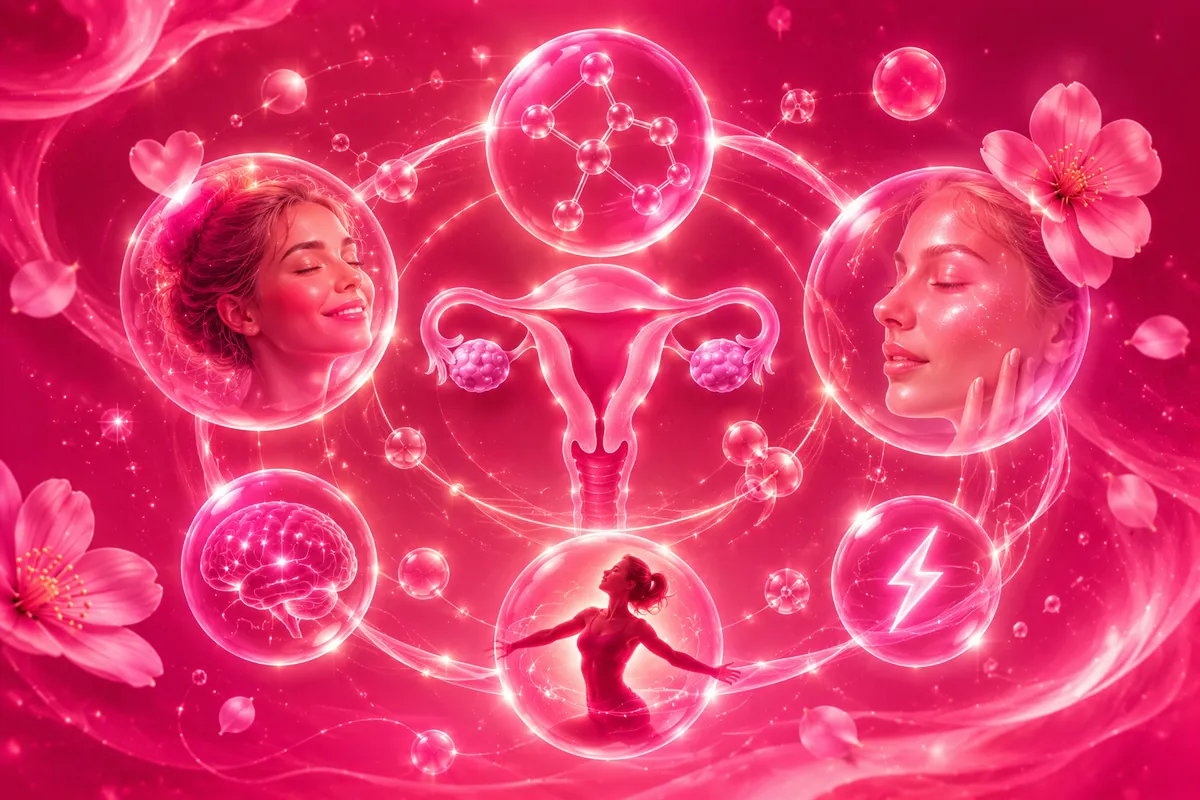
Meet the Four Hormones Quietly Running Your Month
Somewhere between your morning coffee and your evening wind-down, decisions are being made about how you feel.
Not by you, exactly.
By four chemical messengers moving through your bloodstream in tides so precise they could set a clock. One week they lift you; another they soften you. They brighten your skin, then quiet it. They sharpen your focus, then turn it inward.
We tend to blame our moods on the day, the weather, the people around us. Often, the truer explanation is smaller than a raindrop and already inside us.
These are your hormones — and they aren't chaos. They're a cast of characters, each with a personality, a moment to shine, and a job to do.
Once you know who they are, the month stops feeling like a series of unexplained moods and starts reading like a story with a recognisable rhythm.
Estrogen: The One That Makes You Feel Unstoppable
If your hormones were a cast, estrogen would be the lead who lights up every room she enters.
In the first half of your cycle, estrogen rises steadily, and as it climbs, so does almost everything you associate with feeling your best. Your energy lifts. Your skin looks clearer and more luminous. Your mind feels quick, your words come easily, your confidence quietly returns.
Estrogen even nudges the brain chemicals tied to good mood and motivation, which is part of why the days of rising estrogen can feel like the wind is finally at your back.
Think of estrogen as the hormone of outward energy — the one that makes you want to start things, meet people, say yes.
But estrogen isn't only about glow. Behind the scenes, it's preparing an egg to be released and thickening the lining of the uterus, doing the practical work of the cycle while making you feel wonderful as a side effect.
The lead never only performs. She's also running the show.
Progesterone: The Calming One Who Turns the Lights Low
If estrogen throws open the curtains, progesterone gently draws them closed.
After ovulation, in the second half of your cycle, progesterone takes centre stage. It's the hormone of inward energy — the one that slows you down, warms you up, and quietly asks you to rest.
Progesterone has a naturally soothing effect on the nervous system; one of the substances it produces acts on the same calming pathways in the brain that many relaxation remedies aim for. This is why the days after ovulation can feel cosier, sleepier, more sensitive.
It's also why the drop in progesterone right before your period can feel so noticeable. When a hormone that has been calming you for two weeks suddenly falls away, the contrast can leave you feeling raw, tearful, or on edge — not because anything is wrong with you, but because the lights just came up too fast.
Progesterone isn't the villain of the difficult days.
It's the friend who was keeping you calm, and whose sudden absence you feel precisely because she was doing so much.
FSH and LH: The Messengers Who Set It All in Motion
Estrogen and progesterone get all the attention. But they never act alone — and they never act first.
Before either of them can rise, two lesser-known hormones send the opening instructions from your brain: follicle-stimulating hormone and luteinising hormone, better known simply as FSH and LH.
FSH is the quiet organiser. Early in your cycle, it travels from your brain to your ovaries with a single request: begin. In response, tiny fluid-filled sacs called follicles start to grow, each cradling an immature egg, and it's these growing follicles that produce the estrogen you feel as rising energy.
LH is the one who gives the signal to release.
When estrogen reaches its peak, it triggers a sharp, dramatic surge of LH — the highest hormonal spike of the entire cycle. Within roughly a day of that surge, the ripest follicle bursts and releases its egg. Ovulation, the moment the whole month has been building toward, is set off by this single, decisive command.
You never feel FSH and LH the way you feel estrogen's glow or progesterone's calm. They work like stage managers in the dark — invisible to the audience, yet nothing happens without them.
Why the Balance Matters More Than Any Single Hormone
Here's the idea that reframes everything: no hormone is "good" or "bad."
They're a relay, not a competition.
Health in your cycle doesn't come from having more estrogen or less progesterone. It comes from the timing — each hormone rising when it should, peaking on cue, and stepping back to let the next one lead. The handoff is the whole point.
This is why so many everyday things can ripple through how you feel. Chronic stress raises cortisol, and cortisol can interrupt the delicate signals from your brain that start the whole sequence. Too little sleep, extreme dieting, or burning the candle at both ends can quietly nudge the timing off, and you feel it as irregular cycles or heavier moods.
Your hormones aren't fragile. But they are listening — to how you rest, how you eat, how safe your body feels.
When you care for the basics, you're not just being healthy in the abstract. You're helping four messengers keep their timing, so the whole month flows the way it was designed to.
When It's Worth Asking for Support
Most hormonal ups and downs are simply the cast doing its job.
But sometimes the balance drifts far enough to deserve a conversation.
Cycles that become very irregular, mood changes intense enough to disrupt your relationships or work, severe acne, unusual hair changes, or exhaustion that rest doesn't touch can all be signs that the hormonal handoff needs a closer look. None of these mean something is wrong with you — they're simply signals worth bringing to a doctor, who can look deeper than any calendar can.
Understanding your hormones isn't about diagnosing yourself.
It's about knowing the characters well enough to notice when one of them seems to have missed her cue.
Bloom Reflection
The next time you feel radiant for no reason, or tender for no reason, consider that there may be a reason after all — one moving quietly through your bloodstream, right on schedule.
Your moods across the month were never evidence of instability.
They were estrogen lifting you, progesterone softening you, and two quiet messengers setting the whole rhythm in motion. Not chaos. A cast. And now you've been introduced.
Bloom Tips
- When you feel bright and outward, thank rising estrogen — and use that energy for the bold things.
- When you feel inward and sensitive after ovulation, that's progesterone; let yourself slow down instead of pushing through.
- Expect the days right before your period to feel tender — it's the natural drop in calming progesterone, not a personal failing.
- Protect your sleep and ease chronic stress; both help your brain keep the hormonal timing steady.
- See a doctor if mood changes, irregular cycles, or exhaustion start to disrupt your daily life.
Today's Bloom
Notice one feeling in your body today — an energy, a mood, a craving — and instead of judging it, ask which of your four hormones might be leading right now.
You're not looking for a perfect answer.
You're learning to hear the cast, one voice at a time.
Bloom Reminder
You are not "too emotional" or "too much." You are a body in conversation with four hormones — and once you know their names, your month begins to make beautiful sense.