Beauty
What Your Hair Is Trying to Tell You
More shedding than usual? A change in texture? Your hair is one of the body's most honest messengers — if you know how to listen.
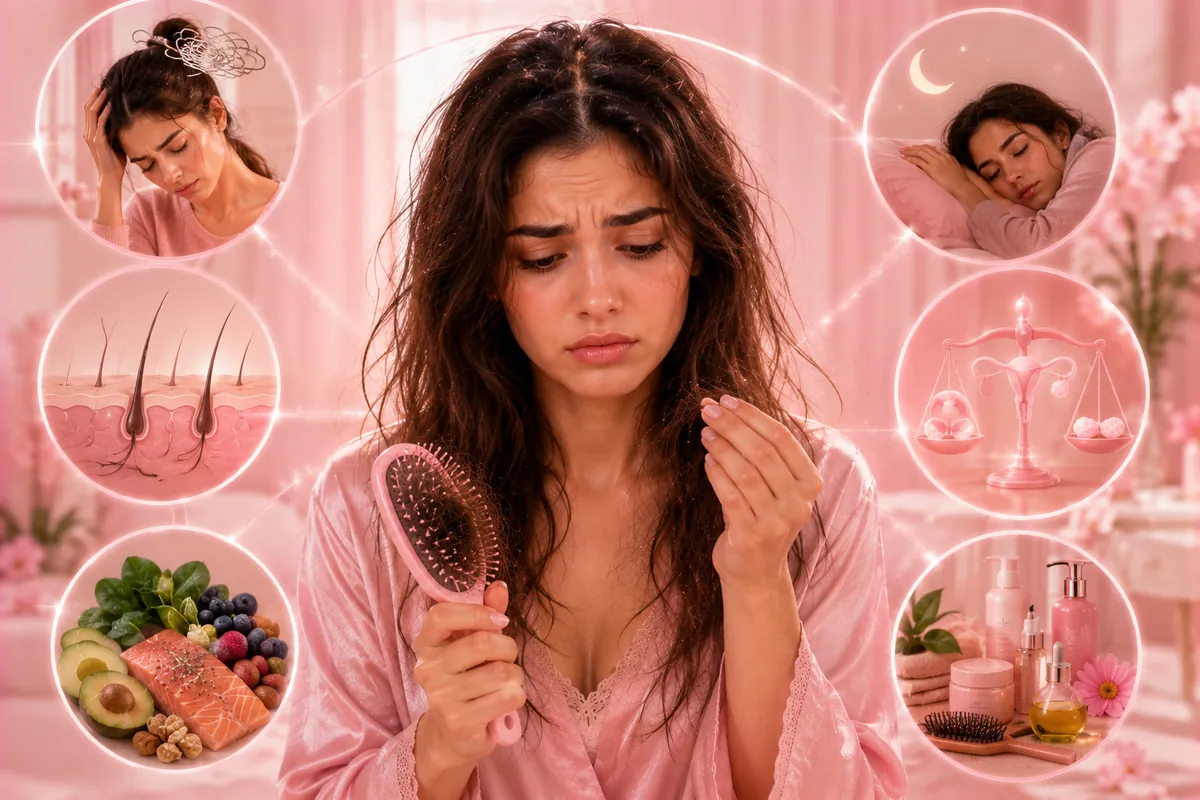
What Your Hair Is Trying to Tell You
It starts small.
A few more strands in the shower drain. A ponytail that feels thinner. Hair that's suddenly drier, or duller, or just… different, in a way no new shampoo seems to fix.
We tend to treat this as a hair problem — something to solve with the right bottle. But hair is rarely just about hair. It's one of the last places your body spends its resources, which makes it one of the first places to show when something inside has shifted.
Learning to read it turns worry into useful information.
Hair Is the Body's Low Priority — on Purpose
Here's the reframe that changes everything: your body considers hair non-essential.
When resources are plentiful, it happily grows thick, shiny hair. But the moment your body is under strain — stressed, depleted, unwell — it quietly reallocates energy and nutrients to the organs that keep you alive, and hair is first on the list to be cut back.
This is why hair reflects your inner state so faithfully. It's the body's honest accountant, trimming the luxury spending the instant the budget tightens.
So a change in your hair is often less about your scalp and more about your whole system.
Shedding Has a Delayed Echo
One of the most confusing things about hair is its timing.
A stressful event, an illness, a crash diet, childbirth — these can push a wave of hairs into their resting phase. But you often don't see the shedding until two or three months later, when those hairs finally fall.
This delay is why hair loss can feel mysterious: the cause has usually passed by the time the effect appears. If you're shedding more now, the honest question is often what was happening a few months ago?
Understanding the lag turns panic into perspective. It's frequently the echo of a hard season you've already come through.
The Usual Messages
When hair changes, it's often pointing at one of a few familiar culprits.
Low iron is a common one — the same mineral that leaves you tired can quietly thin your hair. Stress is another, along with under-eating or very restrictive diets that starve hair of protein and nutrients. Thyroid shifts and hormonal changes play their part too.
@read NU003 | Shedding and exhausted at once? One quiet mineral may be behind both →
None of these are cause for alarm. They're simply the body's way of saying something needs attention — usually nourishment, rest, or a check-up rather than a new conditioner.
How to Actually Help
The kindest hair care often happens far from your bathroom shelf.
Feed it from within: enough protein, iron paired with vitamin C, and the steady nourishment that gives your body the surplus to "afford" good hair again. Protect it from without: gentle handling, less heat, no tight tension pulling at the roots.
And be patient. Hair grows slowly — real improvement shows over months, not days. The strand you nourish today is a story you'll read next season.
Bloom Reflection
It's easy to feel betrayed by changing hair — to chase product after product, quietly anxious, wondering what you did wrong.
But your hair was never betraying you. It was reporting — faithfully, if a little late — on how well the rest of you was being fed, rested and cared for.
Listen to it, and it becomes less a source of worry and more a gentle messenger: a reminder that when you nourish the whole of you, the shine tends to follow.
Bloom Tips
- Read a change in your hair as a whole-body signal, not just a scalp problem.
- Remember the lag — sudden shedding often traces back to stress or illness two to three months ago.
- Feed hair from within: enough protein, plus iron paired with vitamin C.
- Handle it gently — less heat, looser styles, no constant tight tension.
- See a doctor for sudden, heavy or patchy loss; it deserves real answers, not another product.
Today's Bloom
Instead of buying something for your hair today, ask it a kinder question: have I been fed, rested and well lately?
Nourish the answer, and let your hair slowly catch up. The best hair care is often just good self-care in disguise.
Bloom Reminder
Your hair was never only about your hair.
It's a quiet messenger from the whole of you — and when you listen, it tells you exactly what you need.